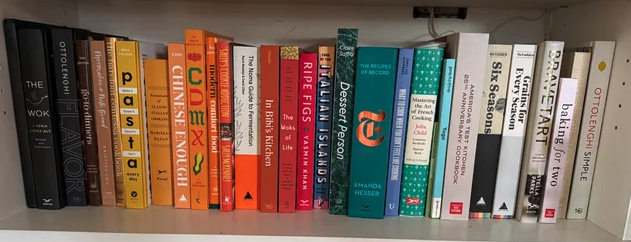
I own 44 cookbooks.
I’ve been collecting them for years, and most of them are barely touched. They look great on my shelf. I’ve bookmarked recipes. I’ve told myself I’ll make that someday.
Someday is 2026.
Starting January 1, 2026, I’m cooking three recipes from a different cookbook every week for 44 weeks. I organized the whole thing geographically—starting in North America, then moving through Europe, Asia, the Middle East, and Africa, before ending with vegetables, baking, and fermentation.
Some of these books I’ve been dying to cook from.
Some of them I’m pretty sure are going to make me cry.
And a few of them? I already have opinions.
The Scoring System
I’m not just cooking. I’m rating. Every recipe gets two scores:
- Outcome: How did it taste?
- CPR (Cussing Per Recipe): How hard was it? How many times did I swear at this book?
A CPR of 1 means it was chill. A CPR of 5 means I questioned my life choices.
Each book also gets scored on ingredient accessibility, instruction clarity, photography, layout, writing voice, and reliability.
The final score is 70% recipe quality and 30% book quality.
Here’s every book I’m cooking through and why.
North America (Weeks 1–17)
I’m starting the year with 17 weeks in North America because it’s January, it’s cold, and I need comfort.
Week 1: What to Cook When You Do Not Feel Like Cooking — Caroline Chambers
This is my on-ramp. Caroline Chambers wrote this book based on her Substack, and the premise is simple: you’re tired, you don’t want to cook, but you still want to eat well. Every recipe is a complete meal: protein, vegetables, starch. If I can’t handle this book in week one, we’re in trouble.
Weeks 2–4: Modern Comfort Food, Go-To Dinners, The Barefoot Contessa Cookbook — Ina Garten
Yes. Three Ina Gartens back to back. I’m not sorry. It’s the dead of winter. I need someone who knows what they’re doing. I need butter. I need “how easy is that?” energy. Ina has been doing this for 25 years, and Go-To Dinners is literally designed for people who want dinner to be easy. That is me. That is the vibe.
Week 5: The Lost Kitchen — Erin French
Erin French is self-taught and runs a restaurant in Freedom, Maine (population 719) that people fly across the world to visit. The book is part cookbook, part memoir. It’s seasonal, deeply New England, and the kind of food where you can taste the place. I’m curious whether it translates to my kitchen.
Weeks 6–7: When Southern Women Cook & America’s Test Kitchen 25th Anniversary
When Southern Women Cook has 323 recipes across 520 pages. America’s Test Kitchen 25th Anniversary has 500 recipes across 608 pages. I’m picking three from each.
When Southern Women Cook is the one I’m most excited about here. It features 60 women and nonbinary contributors—from Vivian Howard to Tiffanie Barriere—covering the entire South. Gullah Geechee rice, Texas barbecue, drop biscuits with sawmill gravy, cornbread, and maybe gumbo. Maybe. Gumbo is a commitment.
Week 8: The Essential New York Times Cookbook — Amanda Hesser
This book has 992 pages and 1,184 recipes. It’s the entire history of American cooking filtered through the New York Times, with recipes dating back to the 1940s. Picking three feels impossible, but also freeing. I can’t be comprehensive. I just have to cook what sounds good.
Week 9: BraveTart — Stella Parks
I’m ending this section with dessert. Stella Parks is a pastry chef, and these recipes are meticulously tested. She also tells the actual history of American desserts. Did you know chocolate chip cookies predate the Toll House Inn? She won the James Beard Award for Baking and Desserts. I’m ready to learn something.
Weeks 10–12: Half Baked Harvest, Pass the Plate, Cook Beautiful
This is the aesthetic section. These books are gorgeous, and I’m curious whether they cook as well as they photograph. Half Baked Harvest has faced serious critiques, which I’ll address in the review. For now, I’ve flagged maple bacon pancakes with bourbon maple syrup, sage brown butter lemon pasta, and spicy Italian sausage tortellini soup.
Pass the Plate by Carolina Gelen is a debut cookbook with Romanian roots. She just won the 2025 James Beard Award for General Cookbook, and I’m rooting for her.
Cook Beautiful by Athena Calderone won the James Beard Award for Photography, so at minimum, it will look nice.
Weeks 13–15: Chinese Enough, Mooncakes and Milk Bread, House of Nanking
Two books from Kristina Cho plus a San Francisco institution.
Chinese Enough is the book I’m most excited about. The title alone understands something about food and identity. Not fully Chinese. Not fully American. Just Chinese enough.
Mooncakes and Milk Bread is her baking book, and I’m a little scared of it. Laminated dough, enriched dough, steamed buns. It won two James Beard Awards…Baking and Desserts and Emerging Voice. This could be a high-CPR stretch.
House of Nanking doesn’t come out until September 2025, so when I cook from it in April 2026, it’ll still be new. It’s the first time the Fang family’s three-generation legacy is in print.
Weeks 16–17: Trejo’s Tacos & CDMX
Danny Trejo wrote a taco cookbook. And honestly? I’m hyped. This book has big energy. Barbacoa brisket that’s dry-brined, then braised. This is going to be banging.
I have a whole list: grilled chicken, fried chicken tacos, breakfast burritos with tater tots, roasted cauliflower tacos, fried avocado tacos, quesadillas, nachos, elotes, guacamole, cheesy bean dip, salsa roja.
Then CDMX by Rosa Cienfuegos takes me to Mexico City—the food chilangos actually eat, from streets, markets, cafes, and bars.
Europe (Weeks 18–21)
Four weeks. Three Italian. One French.
Weeks 18–20: Food of the Italian Islands, Pasta Every Day, Essentials of Classic Italian Cooking
Food of the Italian Islands by Katie Parla covers Sicily, Sardinia, and regions tourists skip. She self-published it, which tells me she really wanted this book to exist.
Pasta Every Day by Meryl Feinstein includes step-by-step photos for every shape and instructions for how to recover when things go wrong. High CPR potential, but at least she’s prepared me for failure.
Essentials of Classic Italian Cooking by Marcella Hazan is 688 pages and was published in 1995. This is the Italian cookbook. The godmother. I put it last because I feel like I should earn her.
Week 21: Mastering the Art of French Cooking — Julia Child
This book has 716 pages. I’m giving it one week. This might be delusional. I’m doing it anyway.
Asia (Weeks 22–29)
Weeks 22–24: The Woks of Life, The Wok, Everyone’s Hot Pot
The Woks of Life is written by four family members, each with a distinct cooking style. The blog is legendary, and this is the cookbook.
The Wok by Kenji López-Alt breaks down the science behind wok hei—that smoky restaurant flavor—across 656 pages and over a thousand photos.
Everyone’s Hot Pot by Natasha Pickowicz comes from a four-time James Beard nominee best known for pastry, which I love.
Yes, I’m making hot pot in June. In summer. I will suffer.
Weeks 25–27: Dishoom, Monsoon, Pakistan
Dishoom reads like a walking tour of South Bombay—400 pages of food, history, and nostalgia.
Monsoon by Asma Khan is structured around six ayurvedic tastes and six Bengal seasons. It’s a philosophy of flavor.
Pakistan by Maryam Jillani is the first major Pakistani cookbook. The first. It spans every region and reflects influences from Afghanistan, China, India, and Iran. This one feels important.
Weeks 28–29: Coconut & Sambal, Paon
Coconut & Sambal by Lara Lee focuses on Indonesian home cooking and sambals…the heart of every meal. I know almost nothing about this cuisine, which is exactly why it’s here.
Paon explores Balinese food beyond the tourist lens: ceremonial cooking, foraging, and zero-waste traditions. Paon means “traditional kitchen.”
Middle East & Mediterranean (Weeks 30–35)
This is the section where I use an unreasonable amount of tahini.
- Ottolenghi Simple focuses on accessibility
- Ottolenghi Flavour dives deep into vegetables and process
- Ripe Figs explores Greek and Turkish food through migration
- Lugma blends Bahraini food with global influence
- Eating Out Loud is joyful, hands-on, family-style Israeli cooking
- Falastin is a love letter to Palestine and voices long unheard
Africa (Week 36)
One book. One week. One continent.
I know that’s not enough.
In Bibi’s Kitchen won the James Beard Award for International Cooking in 2021. Hawa Hassan traveled across eight East African countries collecting recipes shaped by war, loss, migration, and refuge.
It’s heavy. It’s beautiful. It belongs here.
Vegetables & Plant-Based (Weeks 37–40)
Fall is when vegetables shine.
Salad Freak makes salads that eat like meals.
Six Seasons reframes produce through time, not trends.
Grains for Every Season does the same for grains.
Mastering the Art of Plant-Based Cooking treats vegan food as a cuisine worth mastering.
Baking Block (Weeks 41–43)
October. Cookie season.
Sally’s Cookie Addiction is joyful and reliable.
Baking for Two removes math and waste—and lets you bake one cookie at a time.
Dessert Person emphasizes problem-solving and big rewards. Strategic placement.
The Finale (Week 44)
I saved fermentation for last. The Noma Guide to Fermentation is the hardest book I own. Koji. Garums. Black fruits. Science. I put it last because if I put it anywhere else, I’d find a reason to skip it.
Let’s Go
44 books.
132 recipes.
One year.
Some of this will be easy. Some of it will make me cry. I’ll be scoring everything, tracking my CPR, and sharing what I learn along the way. Week 1 starts January 1, 2026. Week 44 ends in early November.
Wish me luck.